Two Hours, One Location, No Fixings: Notes From the Music Video Floor
Photo: No 5 Army Film & Photographic Unit, Stiggins (Sgt), Public domain, via Wikimedia Commons
Nobody puts set dressing on the shot list. That's the first thing you learn on a music video, usually at about 11pm the night before, on a call that starts with the word 'so'.
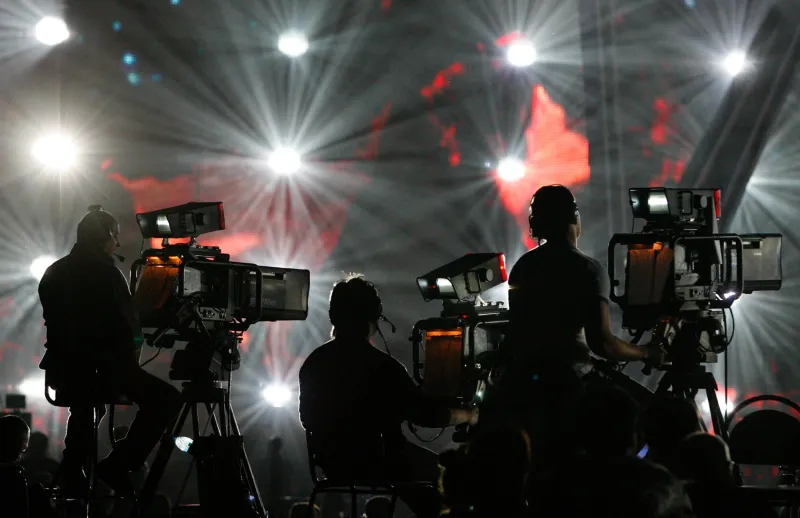
By then the location is locked, the budget is a number somebody said out loud once, and the treatment has a mood board with eleven images that are all in different colour grades. Your job is to make a room read as a specific world for a camera that will not stop moving, and then leave before anyone notices you were there.
What Actually Earns Van Space
On a two-day ad you can take a Luton. On a video you take what fits and you take it fast. My standing list is short: fabric in three weights, a set of risers, a bag of clamps that don't need holes, a box of practical lamps, a roll of colour correction, black wrap, and a crate of hand props chosen for the specific frame.
Everything else is negotiation. If the treatment says 'golden, domestic, warm', you don't need a full living room — you need a lampshade, two cushions, a rug and something on the wall behind the artist's head. The camera is going to be on a gimbal moving past all of it at speed. Build for the pass, not the room.
Reversible by Default
A hired location is somebody else's house or shop, and the owner is coming back. That single fact should govern every decision you make.
No fixings. Nothing screwed, nothing glued to a finished surface, nothing that leaves a mark after a hot lamp has been on it for six hours. Weighted bases, tension poles with proper pads, museum putty on the low-risk surfaces and low-tack tapes tested in a corner first. If you must attach something to a painted wall, use a method you can demonstrate to the location manager before you use it, not after.
Take a photo of every surface you touch. Take one at the start, one at the end, and keep them until the invoice clears. It's the cheapest insurance in the trade.
Colour Control When You're Not Grading It
On a bigger job, the grade is a conversation. On a video, the grade is whatever the director and the colourist agree at two in the morning, and your set is going to be pushed somewhere you didn't plan for.
So dress in neutrals with one deliberate accent, and let that accent be a physical object you control rather than a painted wall you don't. A single strong colour in a hand prop or a soft furnishing will survive almost any LUT. A whole room in one fashionable hue will fight the grade and lose.
Also: test your practicals. A cheap warm bulb under a shade reads beautifully on camera and appallingly on a phone screen at the monitor. Bring gels, bring diffusion, and accept that half your lighting notes are going to be overruled by a person holding a smoke machine.
Camera-Safe or Cut
When the camera never stops moving, everything in the frame is a continuity risk. A prop that's readable in one shot and gone in the next is a conversation with the editor you don't want to have.
Keep hero objects few and place them where the movement naturally lands: on the table the artist walks past, on the shelf at the end of the corridor, in the mirror that gets caught for four frames. Everything else is texture — and texture should be generic enough that nobody can prove it moved.
Practical rules. No glass where a performer might swing an arm. No loose cable in a path. Nothing that rattles or hums near a microphone. No visible logos unless they're cleared, because a video lives online forever and brand teams are thorough.
The Location Is the Client
You are a guest, and the relationship with the location manager is worth more than any single prop. Arrive with the plan written down. Confirm the loading access, the power, the lift, the bin situation, and the exact time you have to be out.
Then be the crew that leaves the place better than they found it. Sweep. Put the furniture back to the photo. Take your gaffer tape with you, including the bits under the table. Word travels quickly among location owners in a city, and a reputation for leaving no trace gets you the good house next time.
Handover at 3am
The last hour of a video is always the same hour. The camera department wants one more take, the artist wants a costume change, and you want to be packing.
Have a strike plan before you have a shoot plan. Two people, a clear order — practicals, then hero props, then soft dressing, then tape and marks — and a van loaded the same way it was unloaded. Anything that has to be re-hung or re-dressed for a pick-up goes in one marked box with a label and a photograph inside the lid, because the person who does the pick-up will not be you.
What the Budget Doesn't Cover
It doesn't cover the second location that gets added on the day. It doesn't cover the fact that the room is smaller than the scout photos suggested. It rarely covers a runner, so assume you are the runner.
What it does cover, if you're careful, is a small, well-chosen kit, a good relationship with the location and the two or three objects that make the frame. That's the whole craft in this corner of the industry — making a lot out of a little, quickly, and then disappearing.