The Rep Theatre Advantage: How Smaller Stages Are Out-Designing the Screen
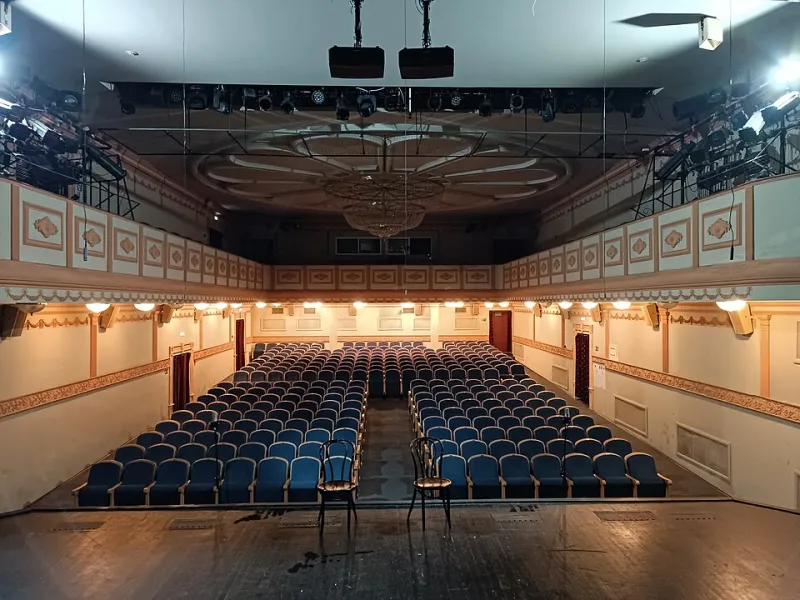
Photo: Gerarus, CC BY 4.0, via Wikimedia Commons
The received wisdom in British production is that innovation trickles down: a big film spends the money, invents the look, and everyone else copies it two years later. Spend a season watching regional theatre in this country and that story stops making sense.
Walk into a mid-scale rep on a Tuesday and you'll see a set that has solved three problems before the first line is spoken — how to change worlds in a blackout, how to tour it to a venue with a smaller stage, and how to build the whole thing for less than the cost of a screen production's portacabin hire. That isn't a compromise dressed up as style. In a lot of cases it's better design.
The budget that deletes the middle
Regional theatre rarely has the cash for the middle ground. You can't afford forty tasteful, expensive, resolutely neutral pieces, so you don't try. You commit: one gesture, one material, one colour, one piece of furniture that carries the whole room.
Screen work often suffers from the opposite problem. There's enough money to avoid deciding, so a set gets filled until it looks like a rental agreement. Theatre designers we've spoken to around the country describe the same discipline in different words: with no budget for hedging, the design has to mean something. That's a useful brief to hand a screen designer, even one with a healthy account.
Three weeks instead of three months
A rep might have weeks between the design being signed off and the first preview; a returning show might have days. Deadlines like that compress decision-making into a shape that suits the work. Drawings get made because they have to be made. Samples get tested because the paint shop is booked. Problems get solved in the room rather than in a chain of emails that runs through four departments.
Faster isn't automatically better, obviously. But theatre's habit of prototyping at scale — a card model, a paint sample, a mock-up of the one tricky corner — is cheaper than discovering on the shoot day that a sightline doesn't work.
Reuse isn't a compromise, it's a language
The Theatre Green Book has pushed sustainability from a nice idea to a working methodology in UK venues, and the results are visible on stage: stock pulled from the theatre's own store, rep plots shared between shows, timber that comes apart into a labelled kit, scenery designed to be re-clad rather than rebuilt.
Screen production has a habit of treating reuse as a slight — the shameful cousin of a proper build. That's changing, but slowly, and mostly at the level of individual designers rather than the schedule. Theatre got there first because it had to, and because the same building has to hold three unrelated worlds in a single season without looking like it's making do.
Flexibility designed in from day one
Watch how theatre handles the get-out and you'll see a discipline screen rarely applies. A touring set has to fit a van, survive a load-in, work in a room with different sightlines, and be out by midnight. Repping means a set has to co-exist with another show's set in the same fly tower.
Translate that to screen and you get something genuinely practical: sets designed for the second series as well as the first, dressing that can be struck and re-dressed in a different order, hero pieces that travel and background that gets built on site. The theatre question — can we take this apart in the dark? — is a very good question to ask of any build.
The workshop advantage nobody is using
Here's the part that puzzles us. Most UK cities with a working rep also have a scenic workshop, a paint shop and a pool of makers who can build a false wall, age a door, upholster a chair and match a wallpaper. Producers chasing crew in London and Manchester often forget that these workshops exist and are frequently available for hire between productions.
They come with caveats. Theatre flats are light, built to be flown not leaned on, and they don't always hold up to a long lens. But as a source of labour, skill and materials knowledge, the regional scenic workshop is one of the most underused resources in British production.
Materials that behave honestly
With no money to hide the join, theatre turns the join into a decision. Scaffold, timber, board, muslin, paint, dye, rope, vinyl, cardboard, a single good chair. Nothing pretends to be a real wall, which means the audience stops asking whether it is one.
Screen doesn't have that luxury — naturalism is the house style — but the underlying lesson survives. Spend on the surfaces the camera will actually see: the handle, the worktop edge, the scuff at the door frame. Everything else can be honest and cheap.
Five things worth stealing
- Decide the hero gesture. One object, one material move, one colour. Dressing follows.
- Design the get-out. If it can't be struck quickly, it'll cost you later.
- Treat hire stock as a palette. Theatre designers know which local store has the good chairs. Screen departments often start from zero.
- Budget labour as well as materials. A day of a maker's time is usually cheaper than a week of compromising.
- Prototype in the room. A quarter-scale model and one painted sample will save a set.
Where theatre could learn back
In the interests of fairness: regional theatre sometimes mistakes visible invention for finished design, and the roughness that reads as bold in a 400-seat house can read as unfinished on a 4K camera. Screen's obsession with neutral, flexible dressing exists for good reason — continuity, re-shoots, coverage. Theatre could borrow some of that discipline, and in a few mid-scale houses it already is.
But the traffic shouldn't only run one way. British theatre has spent a decade proving that constraint produces decisions, that reuse can be designed rather than apologised for, and that a good idea beats a big budget more often than anyone in film and TV likes to admit. Regional reps are quietly setting the pace. The screen side should be watching.