Ten Rods and a Wonky Shed: Dressing an Allotment That Looks Lived In
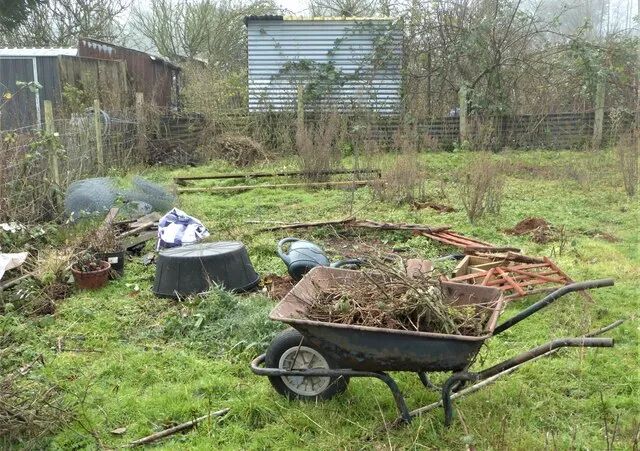
Photo: pam fray , CC BY-SA 2.0, via Wikimedia Commons
Every allotment site in Britain has the same three plots. There's the immaculate one with the ruler-straight onion rows, the one that's been abandoned since a greenhouse blew out in a storm, and the one in the middle where somebody is doing their best with a broken fork and a lot of enthusiasm.
That third plot is the one directors want, and it's the hardest to build, because 'doing their best' is a very specific visual register. It's not tidy and it's not derelict. It's a working site with improvisation in it.
This is the set that will betray you fastest. A garden reads as fake at a glance, in a way a living room never does — audiences garden, or their parents did, and they know what a real plot looks like in June.
What a Worked Plot Actually Looks Like
Start by thinking about time rather than stuff. A plot that's been worked for eight years has layers: things bought, things inherited, things scavenged, things that were meant to be temporary in 2019 and are now structural.
So the dressing list isn't a shopping list, it's a stratigraphy.
- A path that changes surface halfway along, because someone ran out of bark chippings and finished with bricks from a skip.
- A compost bay made of pallets that are three different shades of grey.
- A water butt plumbed in with a bit of hosepipe and hope.
- Cane wigwams still standing from last year, bare and sagging.
- A plastic chair that has gone chalky from UV.
None of that is expensive. All of it needs to be sourced deliberately, because a set dresser buying new pallets is the fastest way to make a plot look like a garden centre display.
The Shed Is the Star
If you're spending money anywhere, spend it on the shed. A perfectly square shed with a new felt roof reads as a prop; a shed that leans a few degrees and has a door that doesn't quite meet the frame reads as a life.
What to look for when sourcing: feather-edge boards with silvered, uneven weathering; a felt roof patched with a second layer over the first; hinges that have been moved once; a window made from a single pane with putty gone hard. Reclaim yards, farm sales and Facebook Marketplace will all have candidates, usually for less than the cost of materials to build a fake one.
Dress the interior too, even if you only shoot through the doorway. Seed packets pinned to a beam, a tin of twine, a hand fork stuck in a pot of compost, a calendar two months out of date. The out-of-date calendar is doing more work than you think.
Labels and the Paper Trail of a Year
Plant labels are the cheapest character detail on any plot and the one most often got wrong. Nobody writes plant labels with a label maker. Nobody uses a fountain pen.
What you want is pencil on a wooden lolly stick or the back of a cut-up yoghurt pot, in handwriting that gets lazier further down the row. Spelling that's approximate. One label written in a child's hand because the grandkid helped.
Then build the wider paper trail: a folded seed catalogue with a page turned down, a hand-drawn plan on the back of an envelope, a plastic tub of assorted labels already used and crossed out. All of it survives weather and none of it needs to be legible on camera.
Tools With Provenance
New tools are the giveaway. A carbon-steel spade with an ash handle that's been sanded by hands for years looks nothing like a hardware shop spade, and no amount of tea-staining will fake the shape of a worn handle.
Build a small hire kit around four or five genuine vintage pieces — a fork, a spade, a rake, a hoe, a watering can with a dented spout — and fill in with modern tools that look used: mud in the treads, rust on the ferrule, twine wrapped round the shaft. Buy from car boot sales and house clearances, keep them dry, and accept that they'll be the first thing anyone tries to walk off with.
Planting That Survives the Shoot
This is where allotment sets fail in practice. Real allotments are plants; sets are schedules. You need green that still looks alive after eight hours under a July sun and a lighting rig.
A working approach:
- Anchor with structure. Cane frames, netting, brassica cages, fruit bushes in pots. Structure looks the same at hour one and hour ten.
- Cut and replace. Leafy crops and herbs in trays of damp compost, swapped out at lunch. Buy in bulk from a garden centre the day before, keep them shaded and watered.
- Go for tough species. Chard, kale, rosemary, lavender, sage, comfrey. They hold their shape, they're authentically British, and they don't flop dramatically.
- Mix in the untidy. A plot where every plant is a crop looks styled. Borage, nasturtiums, a corner of nettles, and a patch of bare, dark, carefully raked soil do more than another row of lettuce.
- Respect the season in the script. If the scene is set in March, you cannot have courgettes in fruit. Get this wrong and you'll hear about it from someone's nan.
If the schedule crosses seasons, keep a photo board of the plot from the first day and check it every morning. Plants grow. Trays get moved for lights. Someone waters a bed that was meant to look dry.
Weatherproofing Without Looking Plastic
Silk plants on an outdoor set are a last resort, and they will be spotted. If you must, use them for background depth only — nothing in the foreground, nothing the camera can walk past slowly.
Better options: weighted pots so nothing tips in wind, hidden irrigation for real plants, moss and dark compost brushed into joins so nothing reads as freshly laid, and a supply of matching soil to patch footprints at the end of each take. Take a bucket of the site's own earth, not bagged compost, or the tone won't match.
Sourcing, UK Style
Your best contacts are the allotment societies themselves. Many sites have open days, plant sales and a shed full of surplus kit that members will lend or sell for a donation. The National Society of Allotment and Leisure Gardeners can point you at local associations. After that: garden centres for trays of living stock, reclaim yards for sheds and pallets, car boot sales for tools, and the ubiquitous back-of-a-van sellers who turn up at every site gate on a Sunday with a boot full of surplus seedlings. Ask permission, leave it as you found it, and put something in the honesty box.
A Small-Set Checklist
- Path materials change at least once.
- Shed is not square and the door catches.
- At least three things on the plot were clearly inherited.
- Labels are pencil, wooden or recycled plastic, and uneven.
- Something is out of date — calendar, seed packet, noticeboard.
- One corner is deliberately neglected.
- Tools are genuinely worn, not distressed.
- Planting holds for a ten-hour day.
- Nothing is identical to anything else nearby.
- There's a mug somewhere, because someone was out here at seven in the morning.
Get those right and you've built a plot the audience will assume has a committee, a waiting list, and an argument about the water butt going back to 2014. Which is exactly the point.